You're not revising, you're rereading

Most UPSC aspirants revise the same way. Open the notes, read them again, highlight a line or two, feel the topic come back, move on. Three weeks later a Prelims mock asks about the same topic and the answer isn't there.
That isn't a discipline problem. Rereading feels like revision, but it mostly isn't. This post covers why, what the learning research actually supports, and a revision loop you can start on one GS topic tonight.
Why Rereading Feels Like It Works
When you read notes you've read before, the material looks familiar. Familiar feels like known. Your brain recognises the page, so it tells you "I've got this".
But the exam doesn't ask you to recognise a page. Prelims asks you to pick the right statement out of four close options. Mains asks you to produce an answer on a blank sheet in under ten minutes. Both need recall: pulling the fact out with nothing in front of you. Recognition and recall are different skills, and rereading only trains the first one.
This is why an aspirant can "finish" Polity three times and still blank on which amendment brought the anti-defection law. The notes were read three times. The fact was never pulled out once.
A simple test: close your notes and write down everything you remember about the topic you revised yesterday. Whatever doesn't make it onto the page is what you actually need to revise.
What the Research Says
This isn't a productivity opinion. It's one of the most studied findings in learning science.
Ebbinghaus (1885) measured how fast he forgot material he had learned. Most of the loss happened early, in the first hours and days, and then slowed. That shape, now called the forgetting curve, is why a topic you "finished" last month feels new again.
Roediger and Karpicke (2006) had students either reread a passage or try to recall it. On a test a few minutes later, the rereading group did about as well or slightly better. On a test a week later, the recall group remembered clearly more. Rereading wins the short game and loses the one that matters.
Dunlosky and colleagues (2013) reviewed ten common study techniques. Rereading and highlighting were rated low utility. Practice testing and spacing out study over time were the two rated high utility.
Two ideas come out of this. First, revise by recalling, not by reading. Second, space the recall out, and come back to a topic just as it's starting to fade, not when it still feels fresh.
The Revision Loop
Here's the loop, step by step. It works for one topic or for an entire GS paper.
1. Recall before you open anything
Take a blank page. Write the topic name at the top and write everything you know about it for five to ten minutes. Headings, articles, committees, cases, numbers, examples. Don't look anything up. It will feel slow and a bit uncomfortable, and that effort is the part that builds memory.
2. Check against your notes
Now open the notes and compare. Mark three things in different colours: what you got right, what you got wrong, and what you missed completely. The missed column is the most useful one on the page.
3. Turn gaps into questions
For every miss, write one question whose answer is that fact. Not a summary line, a question. "Which schedule of the Constitution deals with disqualification on grounds of defection?" is a revision card. "Anti-defection law: Tenth Schedule" is just another line to reread.
4. Schedule the next round
A practical starting rhythm is to come back to the topic after about 1 day, then 3 days, then a week, then 3 weeks. These intervals aren't magic numbers; they're a reasonable default. The rule that matters: if you recall a topic cleanly, push the next review further out. If you blank, bring it closer.
5. Keep a mistake log
Every wrong mock question and every missed fact from step 2 goes into one running list, with the date. Before each mock test, revise the log, not the full notes. Over a few months this log becomes the most valuable document you own, because it's a map of exactly where your memory fails.
A Worked Example: Anti-Defection Law
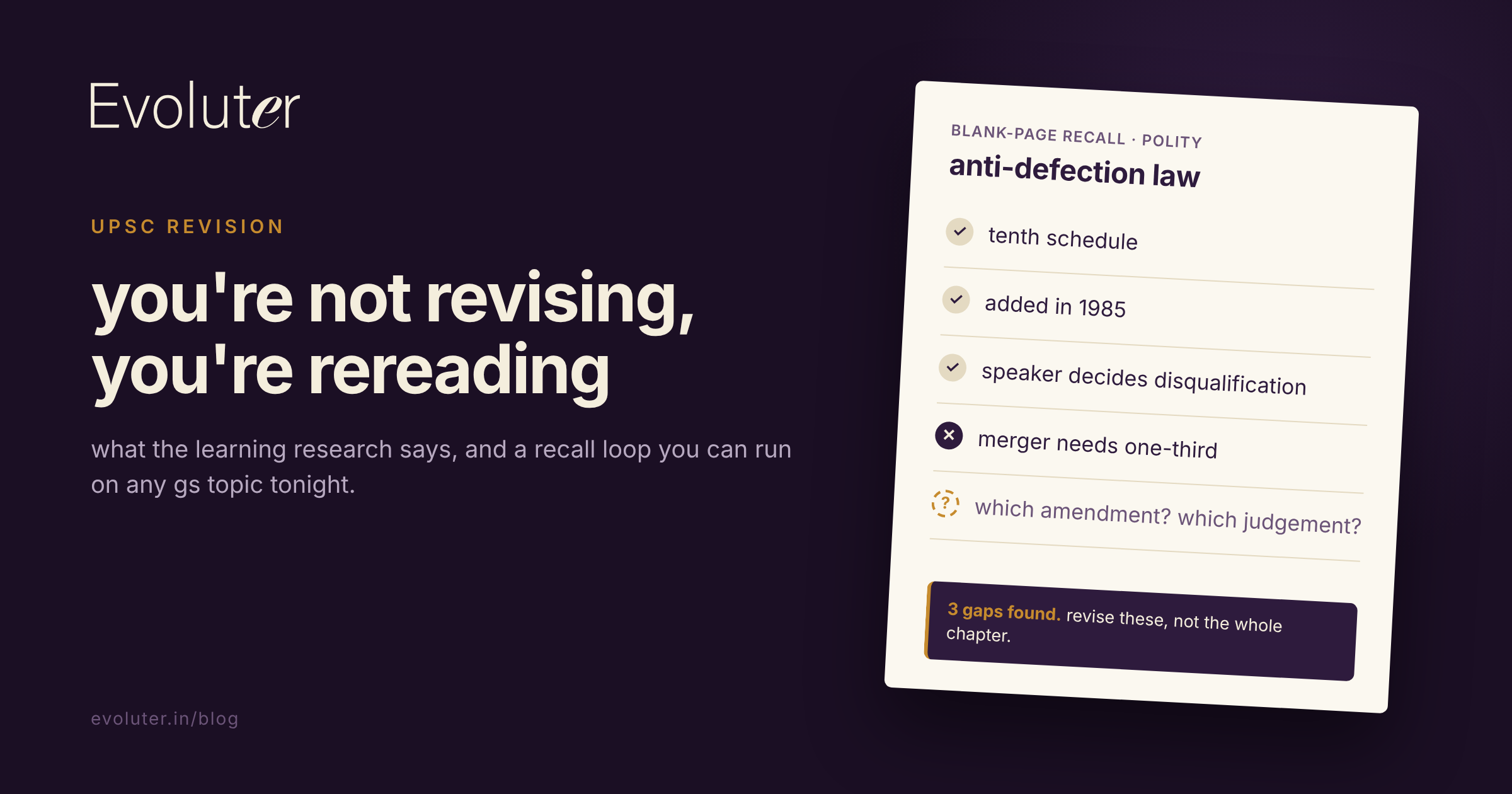
Say you revised the anti-defection law last week. Here's what a blank-page recall might look like, and what the check would show.
Tenth Schedule: Correct
Added in 1985: Correct, but the amendment number was missed (52nd)
Speaker or Chairman decides disqualification: Correct
Merger exception needs one-third of members: Wrong. One-third was the old "split" exception, deleted by the 91st Amendment (2003). A merger needs two-thirds of the legislature party
Not recalled: Missed: Kihoto Hollohan (1992), which held the Speaker's decision is open to judicial review
That's three new question cards from one ten-minute exercise: the amendment number, the merger threshold and the Kihoto Hollohan judgement. Those three cards are your revision for this topic. The rest you already know, so rereading it again would have been wasted time.
Revising for Mains Is Different
For Prelims, recall means facts. For Mains, recall means building an answer. So the blank-page step changes shape: take a previous-year question on the topic and write a 3-minute outline from memory. Introduction angle, three or four body points, one example, one way forward.
Then check the outline the same way. Did you remember a concrete anchor, such as an article, a committee, a report or a judgement? Did you cover the dimensions the question needs? If your outlines keep missing the same thing, say the economic angle or a real example, that pattern is the thing to revise, not the whole chapter.
This is where revision and answer-writing meet. The mistakes that show up in your answers should decide what you revise next.
Where Most Revision Plans Break
The loop above is simple. The hard part is running it across the full syllabus for months without losing track. Spreadsheets fill up, review dates slip, and the mistake log ends up in three different notebooks. Most aspirants drop back to rereading because the system becomes more work than the revision.
That's the problem we're building Evoluter around. The answers you write and the questions you get wrong should feed straight into what you revise next, and when. If your answers keep skipping examples, or you keep missing Polity amendments, your revision plan should change because of it, without you having to maintain it by hand.
You don't need Evoluter to start, though. A blank page, your notes and a calendar are enough. Pick one topic you revised last week, close the notes, and write what you remember. The gaps will tell you what to do next.
Recommended Articles