How we built ai answer-writing feedback for upsc mains
<p>If you're preparing for Mains, you already know the problem. You write an answer, and then you wait. A few days, sometimes two weeks, for a mentor to send back a score and three lines of comments.
If you're preparing for Mains, you already know the problem. You write an answer, and then you wait. A few days, sometimes two weeks, for a mentor to send back a score and three lines of comments. By then you've forgotten what you were thinking when you wrote it.
When we started building Evoluter, this was the first thing we decided to fix. Not MCQs, not video lectures, not another test series. Answer-writing. This post is the honest account of why, what the AI actually checks, and what went wrong on the way.
Why We Started with Answer-Writing, Not Prelims
Prelims practice is already well served. There are thousands of MCQ banks, and an MCQ grades itself: the answer is right or it isn't. You don't need AI to tell you that you picked option C.
Mains is different. There's no answer key. An answer is good or bad because of how you read the question, how you structured it, which dimensions you covered and whether you backed it with something concrete. That judgement has always come from a human mentor, and that's exactly where coaching gets stuck: one mentor, a batch of 200+ students, and a pile of copies that can't be checked fast enough.
So the gap was clear. Aspirants don't lack questions to practise. They lack fast, specific feedback on what they wrote. That's the part that decides marks, and it's the part that doesn't scale with humans alone.
The rule we set on day one: feedback has to tell you what to change in your next rewrite. A score alone doesn't do that.
What the AI Checks in Every Answer
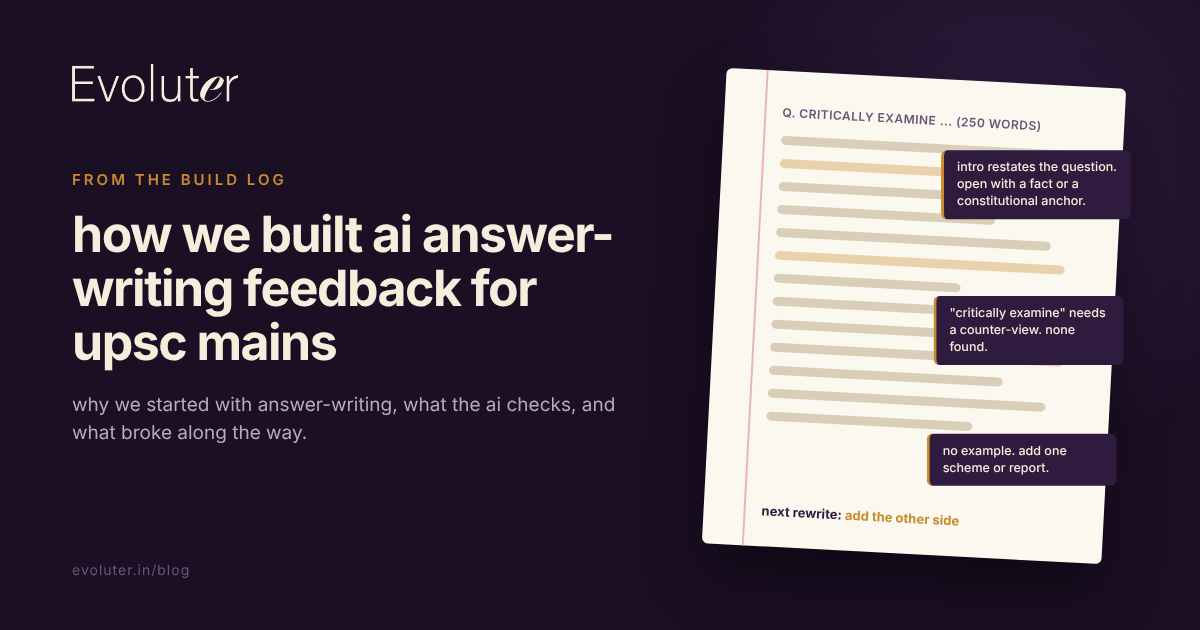
We didn't want a model that reads your answer and says "Good attempt, add more examples." So we broke a Mains answer into the things a good evaluator actually looks at, and the AI checks each one separately.
- Directive: did you do what the question asked? "Critically examine" needs both sides. "Discuss" needs breadth. "Comment" needs your position.
- Structure: an introduction that sets context instead of repeating the question, a body with clear sub-parts, and a conclusion that looks forward.
- Dimensions: whether you covered the angles the question expects: social, economic, political, ethical, environmental, and so on, depending on the topic.
- Substantiation: at least one concrete anchor, such as an Article of the Constitution, a committee, a scheme, a report or a judgement.
- Word limit: staying close to 150 or 250 words. Going far over costs you time in the exam hall.
- Next step: one thing to fix in your rewrite. That's the line we care about most.
The feedback comes back as notes against specific parts of your answer, the way a mentor would write in the margin, plus a short summary of what to fix first.
What Broke Along the Way
A lot. Here are the problems that changed how we built it.
1. The AI Was Too Kind
Early versions praised almost every answer. A weak answer and a strong one got feedback that sounded nearly the same. That's useless to an aspirant. We had to make the checks strict and specific, so that "no counter-view found" is said plainly when it's true.
2. The Same Answer Got Different Feedback
Submit the same answer twice and the comments shifted. If feedback isn't consistent, you can't trust it to track your progress. Fixing this meant scoring against a fixed set of checks instead of asking for a general opinion.
3. Feedback Was Too Long to Use
We first returned a full page of notes per answer. Nobody read past the first paragraph. Now the most important fix comes first, and the rest sits underneath for whoever wants it.
4. Handwriting Is Hard
The Mains exam is handwritten, so practice should be too. Reading photos of handwritten answers, with crossed-out lines, arrows and diagrams, is a much harder problem than reading typed text. We treat it as its own piece of work, not something bolted on at the end.
Who Built It
Evoluter is built by a small founding team: Abhinav Shah, Jainil Shah and me. The AI side was built with Genartml, the AI studio I run, which builds AI automation and custom AI systems for businesses. Building for UPSC was a different kind of problem from anything we'd done before, because "correct" isn't one answer. It's a judgement, and the system has to make that judgement the same way every time.
What's Next
Answer-writing feedback is the core loop, and the next step is connecting it to revision. If your answers keep missing the economic dimension, or keep skipping examples, your revision plan should change because of it. That's what we mean by an AI prep companion, not another test series.
Write One Answer, See the Feedback
Evoluter is opening to early users. Pick any Mains question, write your answer and see exactly what to fix in the rewrite. Join the early access list.
By Daksh Suthar, Co-founder, Evoluter
Author at Evoluter